Visit my Website for all the blurbs, excerpts and news!!

Visit my Website for all the blurbs, excerpts and news!!
Showing posts with label artist. Show all posts

Tuesday, 12 March 2019

Victorian research - The Bustle Dress - with illustrations by Nicole Rubio


When I wrote A Muse to Live For, I spent more time doing historical research than actually writing. It is normal with historical fiction especially if it is your first! I became quite fascinated with Victorian clothes, and I am delighted to have discovered the beautiful art of Nicole Rubio, and to have her permission to use it on my blog as I ramble on a little about the Victorians and their apparel. I hope this post stirs your interest not just in my book, and Victorian fashion, but also in this artist's amazing talent and her deeply moving journey.

"When I could see my work I was too much of a perfectionist and severely blocked. It was only when it became real that it was now or never that I was willing to try. Somehow it felt like I had less to lose if I was starting with a handicap." 

Nicole Rubio


Bustle 8
"Delicate Presence"
Pastel Drawing on Paper
ⒸNicole Rubio 

"What bothers me most is losing color, which I can still see some, but not with the subtlety I could before. I am legally blind, due to a degenerative retinal disease." 

Nicole Rubio


One of the things I had to figure out for this story, where Gabriel/le, my main character does quite a lot of dress-making, dressing up and, ahem, undressing, is how on earth these cmplex outfit were put together, and worn. 
Man outfits of the time were not so very different from modern suits, but Victorian women clothes are… well, there was such a bloody lot of them, to begin with! There is no doubt that getting dressed was a bit of a hassle, although much less than one would think. It would take about fifteen minutes to get ready to go out, from drawers to hat-and-parasol, with a bustle dress of the kind worn by the middle-class woman (or the better dressed lower class, too) in the 1880s. I did choose this decade because bustle dresses are definitely more attractive (at least to me) than the cumbrous bell-shaped crinoline gowns that preceded them, and they seemed to fit my main character’s style much better.
So how would you wear one of these? They look so incredibly complex, that it’s difficult to understand how one can get in or out of them. So I ventured into a journey of discovery, and tried to understand each element of these complicated outfits.
First, a chemise, to go under the corset, and drawers, if you were so inclined. My MC does not believe in drawers, much, and it must be said that a knee-length ruffled, flouncy things lacks a certain sex-appeal to the modern eye. Victorian drawers were not completely boring though. They were crotchless, to begin with, for ease of uh… chamber pot use. That might explain why the can-can was considered such a scandalous dance. Try throwing your leg and skirts far up in the air with a pair of crotchless panties… well, you get the picture. But, if you thought that the love-slit was a modern kinky twist on lingerie, think again…
Then stockings and boots. What? They wore their boots before getting dressed? Why, yes. Before the invention of the zipper, boots were fiddly. Lots of laces and/or tiny buttons. Not easy to work those while wearing a stiff corset that makes it impossible to bend forward with any ease. But you can see that this opens quite some doors to the fetish-inclined mind. Because after the boots one would put on the corset (which contrary to common opinion, a moderately limber woman could well tie by herself, at least after the invention of the hook and eye fastening for the front), and there you have a very pretty image, of a stockinged, booted wo/man in a tight corset… well, mind out of the gutter, Wyvern.  
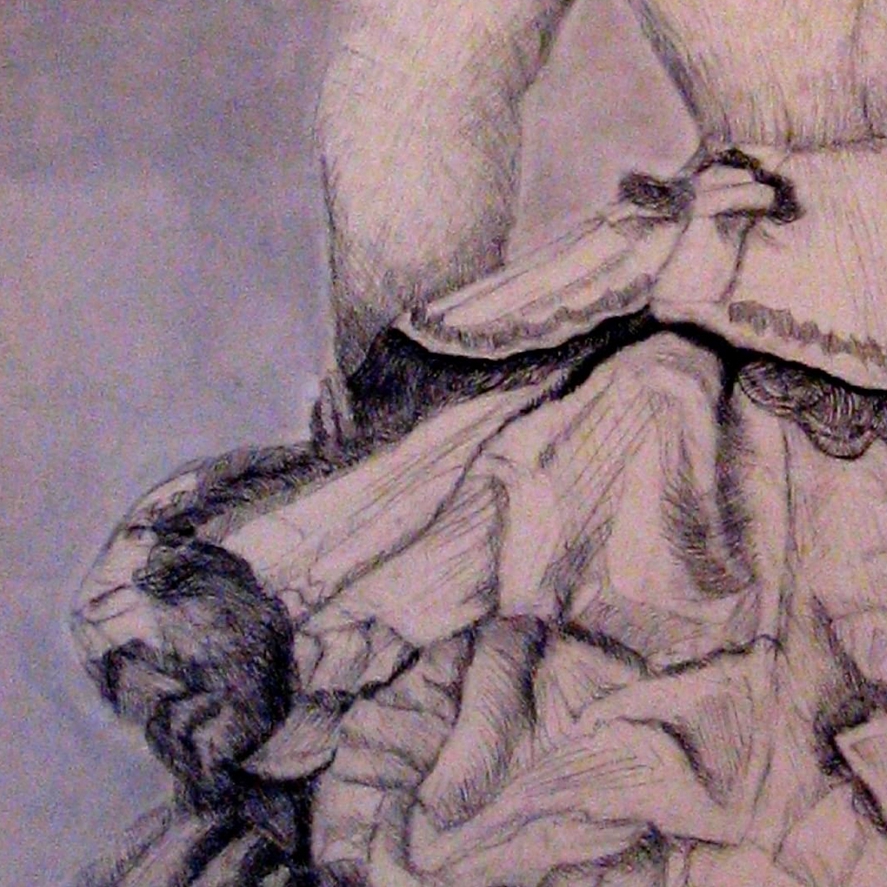

Bustle 1
Pastel and Ink on Paper
Ⓒ Nicole Rubio


"As I have gotten older and my eyesight worse, my work is less about seduction and increasingly about the fear and vulnerability, I feel in facing new situations." 

Nicole Rubio


Add a bustle. The bustle is of course the crucial point of the bustle dress, and the signature element of the fashion of the time. The cheaper ones were basically horse-hair-stuffed pillows one tied over one’s butt to give the skirts a lift behind, and that typical high-rear profile, but the expensive ones were complicated bits of work, including hoops and tabs, and tapes, and complex cages with springs, and even musical boxes, sometimes. I kid you not. All these strange contraptions had to be fastened to one’s waist, and shaped the back of the skirts when one was walking, and folded like a concertina when one was sitting. I am not sure how easy it was to go about one’s business with such a complicated apparatus hanging from one’s ass. But it was certainly easier that the far more enormous gowns worn in former decades.
Over the bustle, a petticoat (underskirt), and a blouse. And then a skirt, and an apron overskirt (the ruffly, draped, upper part of those complex multi-layered skirts).  Over these a taille (basically a tight jacket, matching the skirt), and then all the necessary accessories (collar, gloves, shawl, or a coat, if one could afford it, muff, reticule, parasol/umbrella, bonnet/hat).
It was a lot, and new clothes were expensive. Those were the days when much work was still hand-made and time-consuming. Sewing machines did exist (since about 1846), but they were still slow and they could do little more than “plain work” (straight simple seams), and although the labor force (read: lower classes) were plentiful and paid barely enough to survive (if at all), the complex, highly embellished garments of Victorian fashion were expensive. The middle and upper classes could afford new clothes, but the poorer people most often bought second hand, adapting and fixing them as best they could. Darning is a lost art now, but very much an endless chore at the time. The interesting part of this is that a handy lower-class girl could very well wear very pretty clothes, if a bit faded. Even boots were sold and worn again until each owner found them too disreputable, and resold them to someone less picky or more desperate. 


 Bustle 15 
“Tuffet in the Rain”
Pastel and Graphite Pencil on Paper
Ⓒ Nicole Rubio 


“For an artist capturing the outer world, what matters most is the light. For an artist capturing the inner world, what matters most is honesty.”

Nicole Rubio


And when clothes became really unwearable? There was still a lot that could be done with them. Even the poorest rag was valued and could be bought and sold and put to use. Sometimes in fascinating ways. For example the front of a gentleman’s vest, with all those time-consuming button-holes (if you have ever hand-sewn a button-hole, you will know that those are represent real value) could be reused to fashion the top of buttoned boots. At the very least old fabric could always be taken apart for making new yarn, which in turn was used to make a new fabric called “shoddy”.


Please visit Nicole's website to see more of her magnificent bustle drawings, and find out much much more about her art and writings.

You can also follow Nicole on Instagram

@nicolerrubio

Special thanks go also to my Instagram friend @mauveink, who generously shared her knowledge and expertise when I was researching obscure dressmaking details for my story.


Friday, 15 February 2019

Daphne (Metamorphosis) - a pencil drawing

I have been slack lately in posting my drawings on the blog. I will pick up again, starting from my freshly finished, slightly gender-bending Daphne.

"Daphne (Metamorphosis)" 
Pencil on paper
35x50cm
© Katherine Wyvern 2019


"...a heavy numbness seized her limbs, thin bark closed over her breast, her hair turned into leaves, her arms into branches, her feet so swift a moment ago stuck fast in slow-growing roots, her face was lost in the canopy. Only her shining beauty was left."


When people read the myth of Daphne's Metamorphosis (narrated by Ovid, quoted above, and others), They usually take away two moral lessons. First, that Apollo was an abusive brute who could not take no for an answer.  Second, that in however much trouble one may be, asking help from the gods is a mistake because their idea of 'help' can be a tad bizarre. 
Both these things are probably true, but many readers miss the most poetic bit of this story. 
Which is, that even after she ran from him, and morphed into a tree, Apollo still loved her. That is why the bay tree became sacred to him.
"My bride," he said, "since you can never be, at least, sweet laurel, you shall be my tree. My lure, my locks, my quiver you shall wreathe."
He may have been the first tree-hugger in history. But there is a terrible beauty in this. 
This was supposed to be my Valentine post, but I could not finish the drawing in time. Perhaps a little grim as a Valentine story, but love is a complicated business, and red roses don't begin to cover it. 

Model, the ever-wondrous Danila Kovalev. 
Pencils, Faber Castell Graphite Pure, mostly 6B, 8B and 9B.
The "laurel" is not an accurate botanical representation. 
 

Wednesday, 6 February 2019

Valentine Present - A Muse to Live For


A Muse to Live For

is coming to you on

♥♥♥ VALENTINE DAY ♥♥♥


This is especially cute because February 14th is also my birthday. It is a nice present indeed, to have my favorite story ever published on this particular day! 

Here's a taste of the first chapter.

✥✥✥


Chapter One

“Deep into that darkness peering, long I stood there wondering, fearing,
Doubting, dreaming dreams no mortal ever dared to dream before;
But the silence was unbroken, and the stillness gave no token,
And the only word there spoken was the whispered word, “Lenore?”... ”
Edgar Allan Poe, The Raven

London, November, 1884
Nathaniel
A mirror is an awful thing to have about one’s home.
One can, with care, go about life lightly, without knowing of one’s own existence, which is not a bad state of affairs, considering. Invisible and insensible, one can live on. In a manner of speaking. I, of course, have been a dead man for five years. But one can go on, in a way. In a sort of muffled darkness. Careful not to make a sound, or raise any dust.
Until one has to shave. The mirror stares back at me haggardly, telling the whole tale all over again.
Dead. Dead to the world, and buried in these two darkened rooms.
It is fairly poor taste to disturb the dead, and I resent the intrusion as much as any dear departed would. If only Henry would let me lie in peace.
This mania for the music hall has become a perpetual nuisance. Hardly a month passes that I don’t have to go through this torment. It’s Henry’s way of doing me a kindness, or so he says. Says it will cheer me up. It doesn’t. It’s sickening. But I go anyway, because Henry’s ruckus if I don’t go is worse. Not in the amount of noise and exertion perhaps, but it’s more personal. At the music hall, I just float away. It’s just noise.
It might be easier to go and spend one and a half penny at the barber shop, but I dislike the man’s hands on me. He chatters without pause; his suspiciously pliant and universal political views annoy me; and besides, I’d have to walk the length of the road in my current state of unkempt overgrown shagginess. Worst of all, I would have to pass Mrs. Crabwood’s parlor downstairs. She thinks unshaved men should come and go through the traders’ door, which I would not mind, as such, but her reproving look would be unbearable.
I wish people were not so ready and eager to look me in the eye. If eyes are windows in the soul, should we not grace them with some privacy? There’s not one person on this earth whom I’d want to know my soul, and me theirs.
No, better to face the soulless mirror, and my own darkness. Marginally better, at least. I find scissors and snip unevenly away, before taking up the razor. The scissors are blunt, like everything in here, and each cut pulls at the skin, as if niggling at the puckered proud flesh over a half-healed scab.
The scab being me.
It’s twenty minutes’ walk to Henry’s, most of it along the river. In summer it would be a pleasant stroll, under the spreading plane trees, with the boats plying on the sunny water. Now my boots plash softly into sodden fallen leaves, and slick horse muck. Still, the bare trees looming in the mist have a gaunt beauty, and for a moment, the briefest moment, I wish I had a pencil and a sketching pad with me, to jot down the twisting, muscular forms of their outstretched limbs.
Time was when I never went anywhere without paper and pencils. But that man is long gone.
I am just in sight of number 16, Rossetti’s house—he’s gone these last two years, poor tormented soul, with all his women and his menagerie, may he rest in peace—when a gentleman in a dark coat steps out of a cab not two yards from me and hands out an elegant lady, who turns around to shake out the folds of her gown and unwittingly looks me right in the eye. I shudder, hurrying on.
Really. I mean it. If it’s true that eyes are windows in our soul, why do we look people in the eyes? How many people have you ever known that you’d want to share your soul with? One? Two? Twenty? Fifteen thousand? Or maybe none at all?
****
Gabriel
There is this to be said for my profession.
I can sleep in.
That unspeakable time of day, the early hours of the morning, when the whole world trudges along the streets with dead eyes and heavy feet, on to another day of toil, is spared to me.
I see the tiredness of the world at the other end of the day. But by then it’s dark, and there is not much to see, and the tiredness has a different flavor. To me, that’s mostly the flavor of a man’s spendings, which I mostly spit on the pavement. You get used to it. You get used to almost anything, given time.
Darkness or no, I must be seen of course. I am the one in the stolen foggy spotlight of the lamppost’s golden halo. But the darkness outside stares back blankly, and mostly I like it that way. I have seen enough of the world to last me a lifetime. My business needs the night, in any case.
I wish I could say my bed is warm and comfortable, but mostly it’s lumpy, damp, and cold. But it’s mine and quiet, here at the top of the silent house. If you’d ever spent any time at all in the slums of Whitechapel, you’d know this is downright luxurious.
Mrs. Gride doesn’t like noise. She says it makes her temples ache, which is all stuff of course, but still, we all creep about as quiet as mice. No, much quieter than mice. They do not listen to Mrs. Gride’s injunctions about walking along the drugget, talking in a low voice and making no sounds. I can hear them chewing and scrabbling behind panels and wainscots at night, when the house sleeps, and I come home to my lonely room. Usually they are the only ones to welcome me back. I’m always the last one to return. I feel a bond of likeness with them. We all live at the edge, behind screens. It doesn’t stop me from throwing shoes at them when they cross the room too boldly, or go close to my wardrobe. I have little enough as it is. The mice will have to nest elsewhere. I am not a charity institution after all.
In the morning the bed has a narrow strip of warmth in the middle, a stripe exactly as wide as my body, and I must not move, lest I stray on the flabby, cold linen outside, but still, eventually I find the nerve to reach out and fetch my cigarettes, and light the first of the day. I smoke it in bed, my one and only indulgence. I have become adept at smoking in bed without shedding ashes on the sheets or setting myself on fire.
I watch the thin, ghostly, white smoke curling and floating towards the pale grey skylight, swirling into a puff of breath. It’s likely to be the most beautiful thing I’ll see all day.
I have a small pile of work to do for the girls downstairs, so I finally heave myself out of bed. I don’t ask money for these small jobs. By tacit agreement, I help out, and the girls close an eye on my strangeness. It works very well for all involved.
Later, much later, in the light of a single candle, I shave at my little mirror (an evening ritual, for those like me). As usual I give fervent thanks that nature hardly gave me any beard to shave. Then I shed my trousers and my waistcoat and my shirt and wear my other things.
The stockings, which need mending again, but will do for one more night, in the dark. A small chemise. Then I put on my boots, with small heels and about a thousand fucking tiny buttons that are hell to work with stiff, cold fingers. They are old, second-hand or third, like everything I own, but well-greased and waxed and buffed to a sheen. It’s cold out there, and wet.
And then my tight, tight corset. It needs some fancy bending to lace it up by myself, but I am limber. I pull the laces as tight as I can around my waist, feeling the shape of me change, like some creatures are said to change in the light of a full moon. The core of the corset is whalebone and steel, stiff like armor. It knows my true shape better than my body does. It hardly needs padding at the chest, hard as it is, but it suits me to pad it anyway, for the weight of it, with two silk cravats I keep for the purpose, so old, worn so soft by use, so waxy with the damp of my skin, that they almost melt to my chest. My skin is all tingling now, and it’s not the cold. Silk and steel hug me so close, so much tighter than my day clothes. I am almost naked, and yet every bit of me is more defined and clear, like I have come into sharper, truer focus in the searching eye of a telescope.
I paint my lashes and my eyelids, black and black, to make my eyes shine. I paint my lips red. That marks me as the whore I am, and I don’t mind.
I am what I am.
My wig hangs from the corner of the wardrobe. Freshly brushed, the blonde hair shines in the candlelight and waves like a ghost in the faint breeze as I open the wardrobe door. Maybe the ghost of the woman whose hair it is, who knows. She might well be dead. I don’t know what would be creepier, to wear the hair of a dead woman or the hair of a live one. Still, I’m stuck with the wig for now. I am not pleased with the color, which does not mix with my dark hair. But I got it almost cheap in Middlesex Street. It was the sort of bargain where nobody asks too many questions.
I wear my violet skirt over a small horsehair bustle and a blouse and tight bodice. I don’t button this all the way up, but I put on a shawl, for the cold. The wig, which in summer would hitch and sweat, is almost a comfort now. I look at my mirror one last time as I tie my hair in a loose chignon at the nape of my neck, and stab it through with a horn comb. No pins. I learned the hard way not to trust a man around a hairpin. The mirror is too small to see much. My pale face, the dark circles of my eyes, the red lips, the ghostly locks. All the rest I can only imagine.
But that is my life. Imagining myself, conjuring myself into existence … especially the parts that don’t fit in the narrow, narrow picture.

✥✥✥

 "Daydream" 
Pencil sketch on paper, model D. Kovalev
©Katherine Wyvern 2018