Visit my Website for all the blurbs, excerpts and news!!

Visit my Website for all the blurbs, excerpts and news!!
Showing posts with label art. Show all posts

Wednesday, 8 April 2020

The Art of The Elder Man (Coming Tomorrow!)

Uncovering and divulging  an outlandish conspiracy will put a hard bump into any journalist’s career, and Armin can only blame himself when he’s dispatched from Frankfurt’s skyscrapers into the depths of rural France on the unglamorous job of writing about a cobbing workshop.

Natural building is messy, dirty and sweaty work, but it has its consolations. For example, Van, the greying but undeniably hot master cobber teaching the workshop. Sure, the man is a hopeless tree-hugger, with embarrassing notions about ancient folklore and religions, but he’s still worth a week-long fling, right?

When Van is revealed in all his majesty and power as a long forgotten forest god, however, the week-long fling might well become entangled with eternity, on the edge between life, death, madness, and immortality.


-:- 

I can't wait for tomorrow, and the release of The Elder Man, a story that I have worked on for well over a year. It all began even longer ago, with this drawing I made of Danila Kovalev in January of 2018.
"Cernunnos (1)" 
(model, Danila Kovalev)
pencil drawing
© Katherine Wyvern

It was a drawing of Cernunnos, god of the forest and keeper of the gates of the underworld in Gaulish mythology. This drawing was just an homage to the beauty and magic of the woods around my garden, but it slowly became so deeply rooted into my imagination that Cernunnos finally found his way into one of my notorious "short, light stories" and turned it into a wonderfully deep and textured tapestry of wild nature and ancient magic. Since then I made more drawings for this book, and they became part of the storytelling for me. I have gathered them here, and I hope they express some of the love and awe I feel for Van and his woods.


"Cernunnos (2)"

(model, Henry Ian Cusick) 
Pencil drawing, digital color 
© Katherine Wyvern
-:-
"The Great God Pan (1)"
(model, Henry Ian Cusick)
pencil drawing, digital effects
© Katherine Wyvern
 -:-

"The Great God Pan (2)"
(model, Henry Ian Cusick)
pencil drawing, digital effects
© Katherine Wyvern

-:-
“Why the antlered man? Who is it?” repeated Armin, a little confused, looking at Van.
Van shrugged. “He’s … Amun, and Silvanus and Pan, and the Leshy and Veles and Svyatibor  … even the Minotaur, perhaps. There is a picture of him as old as fifteen thousand years in a cave in the Ariege, la grotte des Trois-Frères. The Sorcerer. Prancing fellow with antlers and a thumping big dong.”
Every woman in the room, including the young girls, giggled.
He grimaced theatrically. “Sorry. All these old horned males. What can I say?”
“Anyway, some would say he’s the Devil, too, and Baphomet. And lately, just the Horned God. It all got twisted about since the Christians started messing with the old deities. And the Wiccans just made one big stew of it all to cover all the bases and be on the safe side. They may not be wrong however. In France, the Gauls came to call him Cernunnos or Carnonos or Cerunincos, which all simply mean the horned one or the antlered one. I suppose we might go with Cernunnos.”

“Wherever you look, there was always a god of the forest, the earth, the water… a god of low places, valleys, sources, meadows. His trees were always small trees. Healing trees. The willow, the elder, the rowan. Not a sky god. Not a war god. He was also, as often as not, a god of agriculture and fertility. And death and healing, even resurrection.  Fall, winter, and spring, the seasons. Nature again. It was easy in the old days to believe in such a divinity. And it was wise to pay tribute to him. Forests, fields, death, rebirth, the cycles and forces of nature were rather more … central.”
 -:-

"Stag Night"
pencil drawing, digital effects 
© Katherine Wyvern
-:-
"At the head of the bed was sculpted a huge tree, which rose from a tangle of roots and interwoven grasses or creepers and spread on the walls and under the ceiling.
It took a sort of knack, a subtle shift in vision and a certain familiarity with Van’s twisting and fractal designs, to realize that the tree was actually two slender stags, rearing up belly-to-belly, muzzles raised, legs grappling. Their massive leafy antlers spread up and out like a petrified fountain and ended in a foamy, lacy, semiformal trellis of finely tooled flower heads.
The stags might be fighting, but seeing how their long cocks and serpentine tongues were entwined in two labyrinthine knots, they might also be doing something else entirely.
Armin blinked, dumbfounded, then blinked again, and uncannily, the tree was just a tree once more..."
-:-

"Cernunnos (3)"
pencil drawing, digital effects 
© Katherine Wyvern
-:-
“There has always been something mystical about the stag and his antlers, in all the old Indo-European cultures. The stag was important enough to have his own constellation, roughly where modern astronomers place Ophiuchus. The Celts put it nicely, saying that the stag carried the solar disk in his crown. His antlers and his strength are greatest in the autumn, they are lost in the winter and emerge again in the spring. He incarnates the death of nature and its awakening. He and Cernunnos are avatars of the fall, of the death of nature and its rebirth. Cycles again.”
-:-
 I am immensely grateful toe Evernight Publishing and Jay Aheer of Simply Defined Art for including my moon cycle illustration in the cover of the book.


Tuesday, 12 March 2019

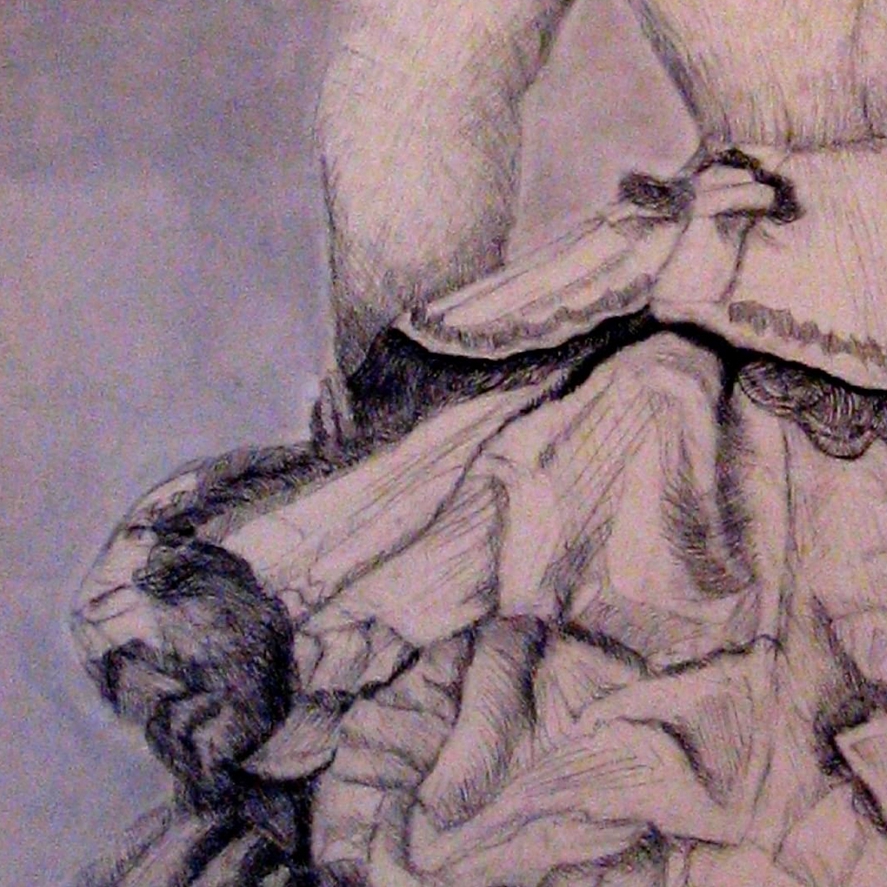
Victorian research - The Bustle Dress - with illustrations by Nicole Rubio


When I wrote A Muse to Live For, I spent more time doing historical research than actually writing. It is normal with historical fiction especially if it is your first! I became quite fascinated with Victorian clothes, and I am delighted to have discovered the beautiful art of Nicole Rubio, and to have her permission to use it on my blog as I ramble on a little about the Victorians and their apparel. I hope this post stirs your interest not just in my book, and Victorian fashion, but also in this artist's amazing talent and her deeply moving journey.

"When I could see my work I was too much of a perfectionist and severely blocked. It was only when it became real that it was now or never that I was willing to try. Somehow it felt like I had less to lose if I was starting with a handicap." 

Nicole Rubio


Bustle 8
"Delicate Presence"
Pastel Drawing on Paper
ⒸNicole Rubio 

"What bothers me most is losing color, which I can still see some, but not with the subtlety I could before. I am legally blind, due to a degenerative retinal disease." 

Nicole Rubio


One of the things I had to figure out for this story, where Gabriel/le, my main character does quite a lot of dress-making, dressing up and, ahem, undressing, is how on earth these cmplex outfit were put together, and worn. 
Man outfits of the time were not so very different from modern suits, but Victorian women clothes are… well, there was such a bloody lot of them, to begin with! There is no doubt that getting dressed was a bit of a hassle, although much less than one would think. It would take about fifteen minutes to get ready to go out, from drawers to hat-and-parasol, with a bustle dress of the kind worn by the middle-class woman (or the better dressed lower class, too) in the 1880s. I did choose this decade because bustle dresses are definitely more attractive (at least to me) than the cumbrous bell-shaped crinoline gowns that preceded them, and they seemed to fit my main character’s style much better.
So how would you wear one of these? They look so incredibly complex, that it’s difficult to understand how one can get in or out of them. So I ventured into a journey of discovery, and tried to understand each element of these complicated outfits.
First, a chemise, to go under the corset, and drawers, if you were so inclined. My MC does not believe in drawers, much, and it must be said that a knee-length ruffled, flouncy things lacks a certain sex-appeal to the modern eye. Victorian drawers were not completely boring though. They were crotchless, to begin with, for ease of uh… chamber pot use. That might explain why the can-can was considered such a scandalous dance. Try throwing your leg and skirts far up in the air with a pair of crotchless panties… well, you get the picture. But, if you thought that the love-slit was a modern kinky twist on lingerie, think again…
Then stockings and boots. What? They wore their boots before getting dressed? Why, yes. Before the invention of the zipper, boots were fiddly. Lots of laces and/or tiny buttons. Not easy to work those while wearing a stiff corset that makes it impossible to bend forward with any ease. But you can see that this opens quite some doors to the fetish-inclined mind. Because after the boots one would put on the corset (which contrary to common opinion, a moderately limber woman could well tie by herself, at least after the invention of the hook and eye fastening for the front), and there you have a very pretty image, of a stockinged, booted wo/man in a tight corset… well, mind out of the gutter, Wyvern.  


Bustle 1
Pastel and Ink on Paper
Ⓒ Nicole Rubio


"As I have gotten older and my eyesight worse, my work is less about seduction and increasingly about the fear and vulnerability, I feel in facing new situations." 

Nicole Rubio


Add a bustle. The bustle is of course the crucial point of the bustle dress, and the signature element of the fashion of the time. The cheaper ones were basically horse-hair-stuffed pillows one tied over one’s butt to give the skirts a lift behind, and that typical high-rear profile, but the expensive ones were complicated bits of work, including hoops and tabs, and tapes, and complex cages with springs, and even musical boxes, sometimes. I kid you not. All these strange contraptions had to be fastened to one’s waist, and shaped the back of the skirts when one was walking, and folded like a concertina when one was sitting. I am not sure how easy it was to go about one’s business with such a complicated apparatus hanging from one’s ass. But it was certainly easier that the far more enormous gowns worn in former decades.
Over the bustle, a petticoat (underskirt), and a blouse. And then a skirt, and an apron overskirt (the ruffly, draped, upper part of those complex multi-layered skirts).  Over these a taille (basically a tight jacket, matching the skirt), and then all the necessary accessories (collar, gloves, shawl, or a coat, if one could afford it, muff, reticule, parasol/umbrella, bonnet/hat).
It was a lot, and new clothes were expensive. Those were the days when much work was still hand-made and time-consuming. Sewing machines did exist (since about 1846), but they were still slow and they could do little more than “plain work” (straight simple seams), and although the labor force (read: lower classes) were plentiful and paid barely enough to survive (if at all), the complex, highly embellished garments of Victorian fashion were expensive. The middle and upper classes could afford new clothes, but the poorer people most often bought second hand, adapting and fixing them as best they could. Darning is a lost art now, but very much an endless chore at the time. The interesting part of this is that a handy lower-class girl could very well wear very pretty clothes, if a bit faded. Even boots were sold and worn again until each owner found them too disreputable, and resold them to someone less picky or more desperate. 


 Bustle 15 
“Tuffet in the Rain”
Pastel and Graphite Pencil on Paper
Ⓒ Nicole Rubio 


“For an artist capturing the outer world, what matters most is the light. For an artist capturing the inner world, what matters most is honesty.”

Nicole Rubio


And when clothes became really unwearable? There was still a lot that could be done with them. Even the poorest rag was valued and could be bought and sold and put to use. Sometimes in fascinating ways. For example the front of a gentleman’s vest, with all those time-consuming button-holes (if you have ever hand-sewn a button-hole, you will know that those are represent real value) could be reused to fashion the top of buttoned boots. At the very least old fabric could always be taken apart for making new yarn, which in turn was used to make a new fabric called “shoddy”.


Please visit Nicole's website to see more of her magnificent bustle drawings, and find out much much more about her art and writings.

You can also follow Nicole on Instagram

@nicolerrubio

Special thanks go also to my Instagram friend @mauveink, who generously shared her knowledge and expertise when I was researching obscure dressmaking details for my story.